rss
twitter

Tuesday, May 31, 2011

Likeable Characters

I have a question for you! Something I've been pondering lately...

In the past half year or so I've read a young adult book and an adult book that deal with the main character cheating with their best friend's boyfriend. In both cases, the best friend was portrayed as insecure, needy, bossy, and selfish. Not to mention that she treated the main character pretty horribly.

So, as a reader, I rooted for the main character to get the boy, despite the fact that she was betraying her best friend. She would claim that her relationship with the boy was deeper than the best friend's relationship, and of course I believed it, because that was how it was presented.

As I read the second one though, I began to wonder - how would I feel about this main character if the best friend were kind, considerate, and selfless? Would it affect how much I enjoyed the book?

I don't think I need a likeable main character to like a book, so long as the character is complex. For example, I loved Lauren Oliver's Before I Fall, and I didn't really care for the main character as a person for most of the book. She was exactly the sort of person I would have disliked in high school. But she was multi-faceted, complex, and - ultimately - she changed. She recognized the ways she was unlikeable, and she grew throughout the book.

I can't decide if I'd rather read a book where the main character cheats knowing her best friend is incredible and just owns up to it, doesn't try to defend her actions by claiming that, in some ways, the friend deserves it. I think there's a good chance I'd be incredibly frustrated with the main character. But I also think that in many ways it will feel more true, more honest. I'm sure not everyone who cheats with their best friend's boyfriend does it because the best friend is actually awful and deserves it.

So what do you think? Do you need likeable main characters?

Tuesday, May 10, 2011

Sidewalk Says...

Every time I walk from work to the grocery store before catching my bus, I pass a particular square of sidewalk that makes me quite happy. Today I finally stopped to take a picture of it...


"There is no greater power than imagination. Believe, and doing becomes easy."

I love whoever wrote that into the sidewalk, because that phrase is great in two ways.

1. It says you can do whatever you believe you can do. I think it's too easy to fail to believe in yourself before pursuing a dream, or even an everyday task.

2. The first half in and of itself: There is no greater power than imagination. Imagination is the foundation of all stories, and I think in many ways stories are vital to the foundation of who we are as people and as a collective.

Both of these things are worth remembering more often.

So, to whoever saw this slab of wet cement and decided to make their mark in it, bravo. Good choice of words. If you ever see me walking to the grocery store, stop me so I can give you a high five.

Friday, April 29, 2011

A Friday Reference to Friday Night Lights

I try not to, but I usually feel the need to defend myself when friends see me reading a young adult novel. I go to a school where being literary and high-brow is much more acceptable than reading the latest young adult release, especially in my writing classes. When I do defend my choices, I cite the same reasons:

These books are good. They are incredibly well-written. Just because they are written with teenagers in mind does not mean they aren't quality. And because I want to write young adult novels, it is important that I read them.

Things happen. And quickly. As someone who depended on murder mysteries and legal thrillers through middle school and most of high school, I need plot. And in young adult, most of the time even the books that aren't high concept still pull you in right away. Because, let's face it, teenagers aren't going to give a book 50 pages to see if they like it.

In high school, every little thing that happens feels like the most important thing ever. It just does. Because in high school we feel so old and grown up and we don't yet know just how complicated and messed up and tough things can really get, so everything that happens to us is either the best or the worst and every crush is a love we'll never get over.

This last reason is why I most enjoy both writing and reading young adult - the intensity and urgency of every emotion. But there's another thing I love: Friday Night Lights. I first started watching the show because my cousin was a regular extra on it, but after the first few episodes, there was no getting me to stop. I don't think it hurt that I began watching it shortly after I moved to Chicago for college, and I was definitely homesick for Texas.

From tvovermind.zap2it.com

I can't say what is so incredible about this show as well as well as this article does (which I found via the incredible Nathan Bransford's blog). But in the article by Sonya Chung, this resonated with me the most:

"FNL reminds us that high school is an entire lifetime.  Everything important that’s ever going to happen to you happens during those four years."


This isn't saying that nothing important will ever happen outside of high school, just that some version of every important thing will likely manifest itself in some way in those four years. That's the great thing about young adult novels - the emotions may be the same as in adult novels, but they're compressed and intensified in this way that reminds you that high school actually isn't everything, but life is indeed short. Sometimes, I think, the world could benefit from certain aspects of our teenage selves continuing with us into adulthood. (Though I'll never mind if the drama gets left behind!)

So young adult novels? They rock. No matter how old you are.

Monday, April 25, 2011

A Holiday Contemplation

I was thinking about Easter, which led to me considering holidays in novels. I could just be drawing a blank, but I can't think of a lot of novels in which a description of a holiday stands out or resonates. (Except maybe Harry Potter, because, let's face it, I'm always thinking about Harry Potter.) I think holidays are often just glossed over because, hey, it's November and Thanksgiving had to happen, or the holiday is just depicted with rather normal traditions.

Easter made me think of this because it's one of my favorite holidays, but nor for a very normal reason. (Though much of it is the religious aspect of the holiday, but I'm not going to focus on that here.) I'm very lucky to have not only grown up with all of my extended family in the same state, and most in the same city, but both sides of my family were also friends. As in, two of my aunts were best friends in high school and actually set my parents up. So my grandparents were all friends, too.

Since we all lived close by, I saw family members from each side together often. But Easter was the only holiday I got to spend with both sides at the same time, and that's why it was always my favorite. Each family would go to their respective churches, then we'd all meet up at a park for a picnic lunch. Then we'd split into teams and play soccer. My grandpas would set up a lawn chair in each goal and we'd all play a long, fun game of soccer. I don't really remember hunting for Easter eggs or a big brunch, I remember the picnic and the soccer - two things that aren't typically associated with Easter.

So, considering this, I'm trying to remind myself that when I do write a holiday into a novel sometimes it's the unconventional traditions that can say the most about the characters and add more to the story. Talking about turkey at Thanksgiving dinner is the easy thing to do, but what about the family whose tradition is pot roast, then a game of poker? That, when applicable to the characters, might make for the more interesting story.

Tuesday, March 22, 2011

"Write Every Day" and all that jazz

A few years ago I read a book about becoming a writer that basically said if you cannot sit down and write something - anything - once a day, you frankly don't have what it takes to be a writer. I think I set down the book after that and mumbled something resembling pshaw. It's not that I thought writing regularly wasn't important, I just didn't buy that if there was a day where you managed to get zero words on the page, you'd never succeed.

We hear all the time of the importance of writing every day. After all, if you write even ten words every day, eventually you will have a finished draft. It might take a while, but it will happen. But if you write 2,000 words, then go out of town for the weekend and write none, well... that's still considerable progress.

Over the past few months I've been doing a lot of revisions, so the new WIP I began in December was very neglected. I was still active in my writing, just not in that project. And as the weeks of revisions for the other project passed, I started wondering if my new WIP was really striking my fancy after all. I opened it up when I had the chance and tried to make some progress on it, but I just kept filling in little scenes I already knew would happen. I struggled to really get going on it, or brainstorm any new scenes or components.

When I finally finished the revisions, I reread everything I'd already written in the WIP to reacquaint myself. Then I wrote some. And the next day I wrote some more. Finally, I was able to focus on it, and as a result I'd get random ideas and inspiration while I walked to work or when I was taking my shower - times when I wasn't even thinking about it intentionally.

I just had finals and all the craziness that finals create, and there were days when I didn't have the chance to write. But because I was writing that book more days than not, it was on my mind even on the days I couldn't put any words on the page. Essentially, I made progress just by having the work engaged in my mind.

That, I think, is the true benefit of writing every day. It's not the number of words on the page, it's the motivation and inspiration that comes from having the story in the front of your mind rather than the back. It is so much easier to sit down and write now than when I only had a chance to look at it once a week, because I'm not sitting down trying to remember where I left off and what happened last in a certain sub-plot. I'm accidentally solving sub-plot issues when I'm doing other things, like watching TV, merely because writing nearly every day leaves me engaged with the story every day.

Do you write every day? What are your feelings on the "Write Every Day" mantra?

Friday, March 11, 2011

A book from my childhood

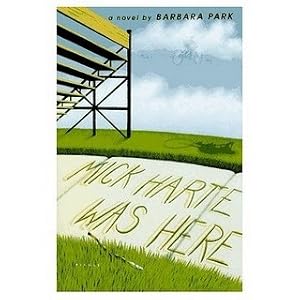
There was one particular book I would not stop reading as a kid - Mick Harte Was Here, by Barbara Park - and when I look back on it, it's sort of weird and morbid that the book I read over and over again was a book about death. A short, middle grade book about a girl whose brother dies in a bicycle accident when they're in middle school. I just reread it last night, and I realize now that one of the reasons I probably loved it so much is the voice. It feels like a friend talking to you, like someone you know and care about, so you want to hear their story, however sad it may be.


But when I was doing an assignment recently for class, I ended up writing about how I often felt creatively cursed by my relatively easy childhood, because I didn't have some huge catastrophe or deeply emotional experience I could call upon as a muse when writing. Only now am I realizing that I probably wrote about death so much in my stories because, for such a long time (truly a blessing), no one close to me had passed away. I was scared of when it would happen, because I'd had no experience with it, so I explored it through writing. And books, I'm realizing - I was drawn to Mick Harte Was Here because it explained how someone dealt with death, one kid to another.

So I'm wondering, has this happened for anyone else? Have you found yourself zeroing in on certain topics or themes in your writing and the books you read because a specific relation they have to your life - even without you realizing it?

And if you can get your hands on that book, I recommend reading it - it's a quick read and full of heart, even so many years later.

Thursday, March 3, 2011

Plans Aren't Mutually Exclusive

Despite the fact that my cognitive psychology class is currently making me question every memory I think I have, there is one conversation with an aunt of mine I remember very clearly. We were discussing what I wanted to be when I grew up, and when I said an author, she said, "But what if you don't become an author?"

I was probably 12 or so at the time, so I was old enough to know that becoming an author was by no means a laid out career plan, but still young enough that I was idealistic. I didn't want to be asked such a realistic follow-up question. Later that day, I wrote about it in one of my many spirals. But I didn't write about the conversation. I wrote, "How am I ever supposed to achieve my dreams if I'm planning for when I fail?"

It wasn't my aunt's intention to crush my dreams or anything. She was just being practical. And though my reaction was that of an idealistic kid, I think it has some practicality to it, too. To someday achieve a dream, you have to believe in it enough to make it Plan A. That doesn't mean it's become an author or be homeless. It's not either or.

Never has this whole conundrum been more apparent to me than now, as my college graduation nears. I think I'm more excited than most of my peers (I hate that word, but it's the best description) for graduating, but I'm not set with a job and a plan and a career all laid out like some of them are. And it's okay. Because at some point when I decided to major in Creative Writing instead of something more practical, I knew this day would come.

And being an author is still my dream. Still Plan A. But what I'm realizing is that pursuing Plan B isn't about giving up, or about failure. It's about practicality. It's about acknowledging that the only way to pursue Plan A is to first find another way to provide for myself. It is not either or. It's Plan B and keeping at Plan A, just at the same time. I haven't failed yet. The only point at which I'll have failed is the moment I stop trying.